 TRIDENTBIOPEPTIDES

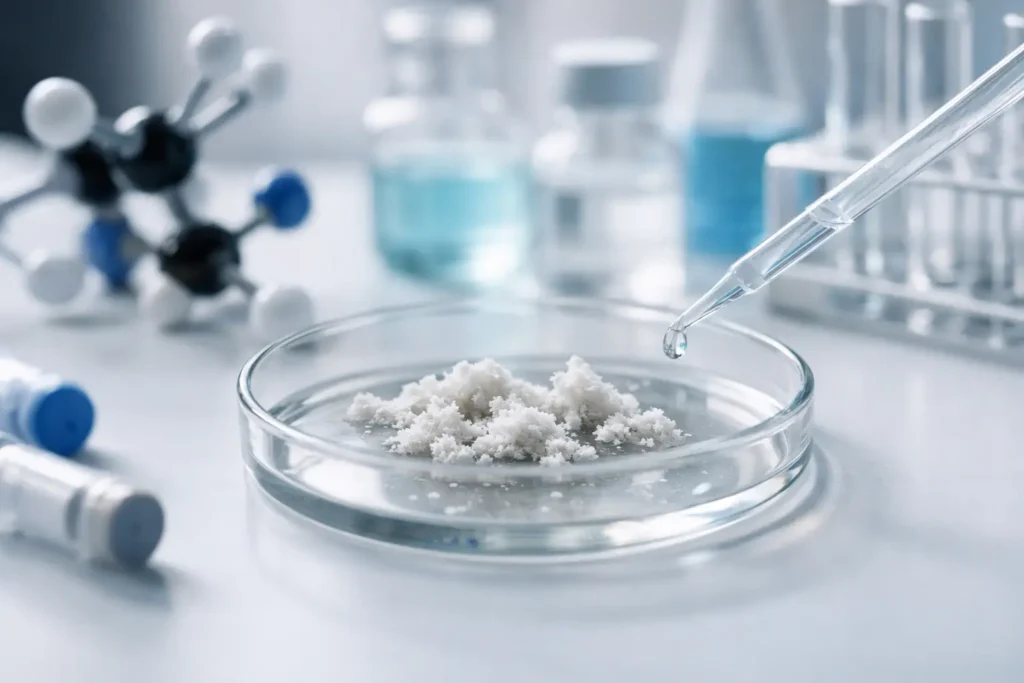
A peptide can arrive as a clean, well-characterized lyophilized material and still become difficult to work with after reconstitution. When researchers ask what causes peptide aggregation, the answer is rarely one isolated failure. Aggregation usually reflects an interaction between peptide chemistry, solution conditions, storage history, and routine handling.
For research teams that depend on repeatable results, the practical concern is not appearance alone. Aggregates can reduce the effective soluble concentration, create vial-to-vial variability, interfere with analytical measurements, and complicate interpretation of downstream data. Identifying the source of instability early protects both the material and the study.
What causes peptide aggregation at the molecular level?
Peptide aggregation occurs when individual peptide molecules associate with one another rather than remaining evenly dispersed in solution. Those associations may be weak and reversible, or they may progress into larger, poorly soluble particles, fibrils, or precipitates. The exact pathway depends on the compound, but the driving forces are familiar: hydrophobic interactions, electrostatic attraction, hydrogen bonding, and structural self-association.
Some sequences are naturally more aggregation-prone than others. Peptides with exposed hydrophobic residues can cluster in aqueous solutions because those regions preferentially avoid water. Aromatic residues may also promote stacking interactions. Repeating sequence motifs, beta-sheet-forming tendencies, and regions with limited charge can further increase the likelihood that molecules align and associate.
That does not mean an aggregation-prone peptide is low quality. It means its chemistry demands a controlled workflow. High purity confirms the identity and composition of the supplied material, but it does not eliminate the inherent solubility and self-association behavior of a specific sequence under every possible research condition.
Sequence and purity are related, but not interchangeable
Sequence design is the starting point for aggregation risk. Peptide length, net charge, amino acid order, terminal modifications, and lipidation can all influence solubility. A highly hydrophobic peptide may require more deliberate solvent selection than a short, strongly charged sequence. Likewise, a modified peptide may behave differently from its unmodified analog even when their core sequences are similar.
Purity still matters because residual synthesis-related impurities, truncated sequences, salts, or degradation products may introduce additional variability. These components can alter solubility, shift pH, or provide surfaces that encourage nucleation. For serious research work, purity verification and consistent formulation reduce avoidable variables before reconstitution begins.
The distinction is operationally useful: intrinsic aggregation risk must be managed through protocol design, while preventable variability is addressed through reliable sourcing, verified material, and disciplined handling.
pH can shift a peptide from soluble to unstable
Solution pH is one of the most influential variables in peptide aggregation. It affects the charge state of ionizable residues and therefore changes how strongly peptide molecules repel or attract one another.
Many peptides are least soluble near their isoelectric point, where their overall net charge approaches zero. With less electrostatic repulsion between molecules, hydrophobic and intermolecular interactions can dominate. A solution that looked clear at one pH may become cloudy, form visible particles, or lose soluble material after a modest pH shift.
Buffer choice matters as much as nominal pH. Different buffer systems, ionic strengths, and excipients can change peptide behavior. A buffer that is appropriate for one compound may not be appropriate for another. Researchers should avoid assuming that a general reconstitution approach will produce the same result across unrelated peptide classes.
Concentration increases collision frequency
Higher concentration creates more opportunities for peptide molecules to encounter and associate with each other. This is why a formulation can remain clear at a working concentration but aggregate during preparation of a concentrated stock.
Concentration is not a simple pass-or-fail threshold. Some peptides tolerate high concentrations with little change, while others show rapid self-association well below expected working ranges. The risk also depends on temperature, solvent composition, pH, and the amount of time the solution remains concentrated.
When the protocol allows, preparing smaller aliquots at a concentration aligned with the planned assay or analytical workflow can reduce unnecessary stress. It also limits the need to repeatedly dilute, mix, or warm a single stock vial.
Temperature and time accelerate instability
Heat can increase molecular motion and collision rates, making it easier for aggregation to begin or progress. Even short periods at elevated temperature can matter for sensitive compounds, especially after reconstitution. Temperature fluctuations during storage, transport within a facility, or repeated access to a shared freezer add additional stress.
Freeze-thaw cycling is a common source of preventable variability. During freezing, solutes can become concentrated in the remaining liquid phase as ice forms. That localized concentration shift may alter pH, ionic strength, and peptide-peptide interactions. On thawing, the peptide may not fully return to its original solution state.
Time is equally relevant. A freshly prepared solution and a solution held for days or weeks may not behave identically, even if both were stored under nominally correct conditions. Stability should be assessed against the actual storage duration and use pattern of the study rather than an assumed universal timeframe.
Handling and surfaces can trigger aggregation
Aggregation does not always begin in the vial. Mechanical stress, air-liquid interfaces, and contact with labware can all contribute. Aggressive vortexing may introduce foam and increase exposure to interfaces. Repeated aspiration and dispensing can create similar stress, particularly in low-volume samples.
Peptides may also adsorb to glass, plastic, tubing, filters, or other contact surfaces. Adsorption reduces the free peptide concentration and can create an apparent loss of material without visible precipitation. In some cases, surface-bound peptide can serve as a starting point for further association.
For sensitive materials, controlled mixing is generally preferable to unnecessary agitation. Use compatible, clean labware; minimize foaming; and keep transfer steps proportionate to the scale of the work. These details are small individually, but they can determine whether a method remains reproducible across runs.
How to reduce peptide aggregation risk
The most reliable approach is to treat reconstitution and storage as part of the experimental method, not as a routine pre-step. Begin with the supplier’s compound-specific handling information where available, then confirm conditions through a small-scale solubility and stability assessment that reflects the intended research application.
Maintain a controlled preparation record that includes the solvent or buffer, target concentration, pH, mixing method, aliquot size, storage temperature, and number of freeze-thaw events. If a change in appearance or analytical behavior occurs, this record makes troubleshooting far more efficient.
A practical control plan should include these four habits:
- Use purity-verified, consistently formulated peptide material to reduce batch-related uncertainty.
- Reconstitute at the lowest practical concentration when the peptide’s behavior is not yet established.
- Divide prepared material into appropriately sized aliquots to avoid repeated freeze-thaw cycles.
- Inspect solutions for haze, particles, color change, or unexpected residue, then confirm concerns with appropriate analytical methods rather than appearance alone.
Visual inspection is useful, but it is not definitive. A clear solution can still contain soluble oligomers or material adsorbed to a surface. Depending on the research objective, methods such as chromatography, mass spectrometry, particle analysis, or spectroscopic assessment may be needed to distinguish degradation, precipitation, adsorption, and true self-association.
When aggregation is a research finding
Not every aggregate represents a handling error. Some peptides are intentionally studied for self-assembly, fibrillation, delivery behavior, or structural transitions. In those cases, the same factors that are problems in a stability workflow become experimental variables worth controlling closely.
The key is to separate intended aggregation from uncontrolled aggregation. If self-association is part of the study, define the concentration, pH, temperature, incubation time, and mixing history with the same precision applied to any other critical assay condition. If it is not part of the study, those variables should be controlled to keep the peptide in the desired state.
Reliable peptide research begins before the first measurement. A carefully sourced material, a documented reconstitution method, and a storage plan matched to the compound give researchers a clearer baseline – and a much better chance of recognizing meaningful results when they appear.