 TRIDENTBIOPEPTIDES

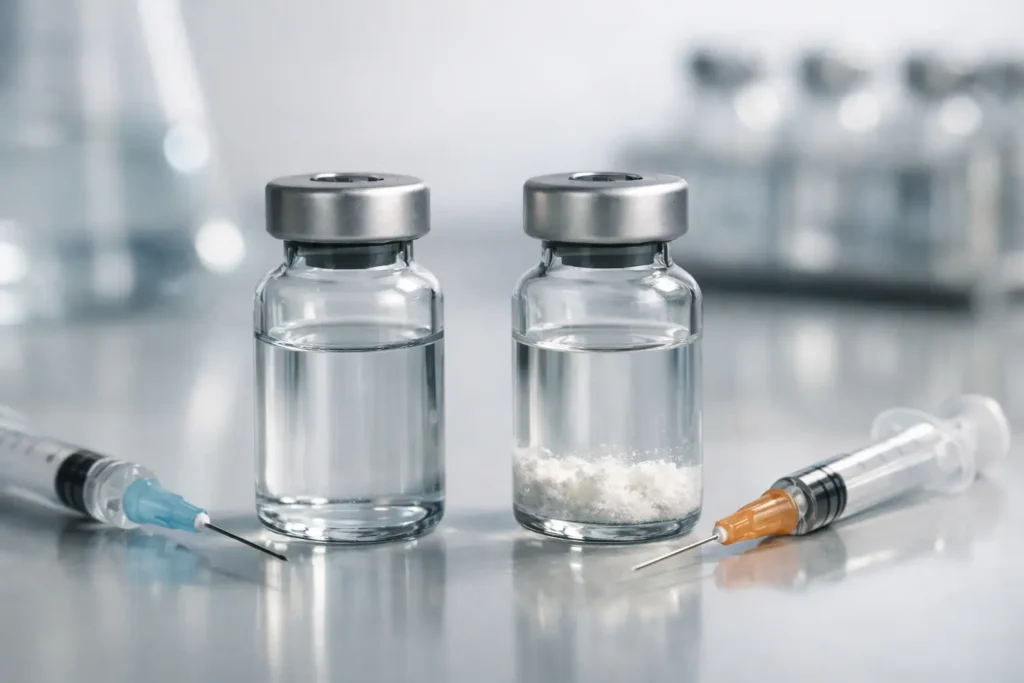
A lyophilized research compound can be purity-verified, accurately filled, and properly stored, yet still produce unreliable work if the diluent is not matched to the protocol. The question of reconstitution water versus bacteriostatic water is therefore not a minor purchasing detail. It affects preservative exposure, repeat-access handling, documentation, and the defensibility of a research workflow.
For serious peptide and research-compound work, the correct choice starts with the material specification and the intended use after reconstitution. These solutions are not interchangeable simply because both may be sterile water-based products.
What Reconstitution Water Means in a Research Setting
“Reconstitution water” is a functional description, not always a complete formulation. It generally refers to a sterile aqueous diluent intended to dissolve or reconstitute a dry material before research use. Depending on the supplier and product specification, it may be preservative-free or may contain additional components. The label, certificate documentation, and applicable protocol determine what is actually in the vial.
In a laboratory setting, preservative-free sterile water is often selected when a protocol calls for a simple aqueous vehicle with no antimicrobial additive. That can matter when a researcher needs to limit formulation variables, assess compound behavior without benzyl alcohol exposure, or follow a method that specifies a preservative-free diluent.
The trade-off is handling sensitivity. A preservative-free solution does not contain an antimicrobial agent designed to reduce microbial growth after repeated vial entry. Once opened or accessed, its suitability depends heavily on aseptic technique, the container’s instructions, the protocol, and the institution’s handling controls. Sterility at purchase does not eliminate the risk of contamination introduced during use.
What Makes Bacteriostatic Water Different?
Bacteriostatic water is sterile water containing a bacteriostatic preservative, most commonly benzyl alcohol. The preservative is intended to inhibit, rather than guarantee the elimination of, bacterial growth that may be introduced after the container is accessed. This characteristic is why bacteriostatic water is commonly discussed in workflows where repeat access to a multidose container is anticipated.
The distinction is meaningful, but it should not be overstated. Bacteriostatic does not mean contamination-proof. It does not replace clean technique, proper closure handling, controlled storage, or documented beyond-use practices. It also does not establish compatibility with every peptide, protein, research compound, assay, or analytical method.
Benzyl alcohol can be a relevant formulation variable. Certain compounds may show altered stability, solubility, aggregation behavior, or analytical response in the presence of a preservative. In other cases, the research design itself may require a preservative-free control. The correct question is not whether bacteriostatic water is broadly “better.” It is whether its formulation supports the specific work being performed.
Reconstitution Water Versus Bacteriostatic Water: Key Differences
The primary difference is preservative content. A reconstitution solution may be preservative-free, while bacteriostatic water contains an antimicrobial preservative. That single difference influences several downstream decisions.
First, consider repeat access. When a workflow requires multiple withdrawals from the same container, bacteriostatic water may be considered when the protocol permits it because its preservative offers an additional control against bacterial proliferation. That benefit remains conditional on appropriate laboratory practice and approved storage limits.
Second, consider compatibility. A simple sterile, preservative-free reconstitution water may be the better fit when the material specification requires no added preservative, when benzyl alcohol may interfere with the compound or readout, or when reproducibility depends on minimizing formulation components.
Third, consider study design. If experimental consistency depends on comparing conditions across multiple samples, every diluent variable should be controlled and recorded. Switching from preservative-free water to bacteriostatic water midway through a project introduces a formulation change. Even when no visible difference occurs, the change can complicate interpretation.
Finally, evaluate labeling precision. “Sterile water,” “reconstitution water,” and “bacteriostatic water” are not automatically equivalent terms. Researchers should confirm the exact composition, stated sterility status, container format, lot information, storage conditions, and expiration date before incorporating any supporting material into a workflow.
How to Choose the Right Diluent
Start with the compound-specific documentation. If the manufacturer’s research specification or an approved laboratory method names a particular diluent, concentration range, or handling condition, that direction takes priority. A general preference for bacteriostatic water should never override a documented compatibility requirement.
Next, define the practical needs of the study. A single-use, preservative-free workflow may be appropriate when a protocol requires it or when the compound is sensitive to additives. A repeat-access workflow may create a stronger case for bacteriostatic water, provided the preservative is compatible and the use aligns with the governing research procedure.
Then assess the analytical endpoint. Researchers working with sensitive bioassays, chromatography, mass spectrometry, cell systems, or stability studies should account for the diluent as part of the experimental system. Benzyl alcohol and other excipients are not invisible. They can affect background signals, sample behavior, or assay performance depending on the method.
Supplier consistency also matters. A high-purity research compound deserves equally clear supporting materials. Look for precise product identification, accessible lot-level documentation where applicable, intact packaging, stated storage requirements, and a supplier that treats formulation consistency as a standard rather than an afterthought. Trident Peptides applies that same precision-first mindset to the research materials surrounding its compound catalog.
Handling Controls Matter More Than the Label Alone
No diluent can correct poor handling. Whether a research team uses preservative-free reconstitution water or bacteriostatic water, consistent technique protects both the material and the data generated from it.
Use only clean, appropriate laboratory equipment and follow the protocol for preparation, storage, and disposal. Maintain clear records for lot numbers, dates of access, final concentrations, diluent identity, and any observed changes in appearance. If the solution shows unexpected particulates, discoloration, cloudiness, compromised closure integrity, or any other sign that falls outside the material specification, it should not be treated as suitable simply because it remains within a printed date.
Storage conditions deserve the same attention. Light exposure, temperature cycling, repeated handling, and extended hold times can affect reconstituted materials. The right storage plan depends on the compound and diluent combination, not on a generic rule applied across every vial. When stability data are unavailable, avoid assuming that a preserved diluent automatically grants long-term stability to the reconstituted research material.
Common Selection Errors to Avoid
One common error is choosing a diluent based on convenience alone. A vial that supports repeat access may be operationally attractive, but convenience is not a compatibility study. The preservative profile must be acceptable for the compound and the intended research endpoint.
Another error is treating “sterile” as a complete quality assessment. Sterility is one attribute. Researchers should also verify composition, container integrity, expiration, storage history, traceability, and supplier reliability. These details shape repeatability.
A third error is failing to document the diluent. If a result later differs from prior work, the reconstitution solution is part of the investigation. Recording only the compound lot while omitting the diluent lot leaves an avoidable gap in the experimental record.
Finally, do not assume that bacteriostatic water is appropriate for every application involving lyophilized materials. Preservatives can be useful in the right context, but they are still additives. The more sensitive the compound or assay, the more important it is to follow validated compatibility information rather than general convention.
A Better Standard for Research Preparation
The strongest approach is specification-led selection. Match the diluent to the compound documentation, control the handling environment, and keep the choice consistent across comparable samples. That process reduces unnecessary variables before a study begins.
For researchers deciding between reconstitution water and bacteriostatic water, the answer is rarely a blanket rule. Preservative-free water may support cleaner formulation control; bacteriostatic water may better suit approved repeat-access workflows. The right selection is the one that preserves compatibility, supports traceability, and keeps the research method disciplined from vial to result.