 TRIDENTBIOPEPTIDES

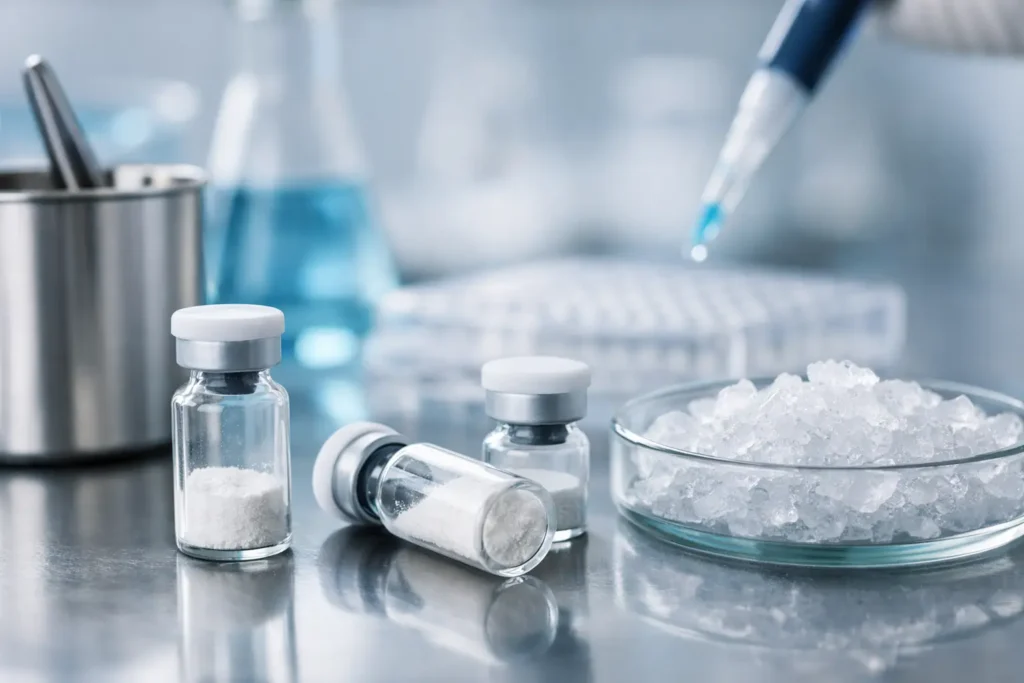
A peptide can be highly pure at release and still become unreliable if its storage form does not protect it from moisture, heat exposure, and time. That is why are peptides lyophilized is more than a handling question for serious researchers. Lyophilization, commonly called freeze-drying, is a formulation and preservation strategy designed to help sensitive compounds arrive and remain in a stable, workable state before reconstitution.
For laboratories that depend on repeatable conditions, the format matters. A properly prepared lyophilized peptide is easier to store, ship, inventory, and reconstitute with controlled volumes than the same material supplied as an aqueous solution. It does not eliminate every stability risk, but it gives researchers a stronger starting point for consistent work.
Why Are Peptides Lyophilized Instead of Supplied in Solution?
Many peptides are susceptible to degradation pathways that become more active in water. Hydrolysis, oxidation, aggregation, deamidation, and microbial growth can all affect a peptide solution, depending on the sequence, buffer system, concentration, temperature, light exposure, and handling conditions. Water is often necessary when a compound is being prepared for research, but it is not always the best long-term environment for storage.
Lyophilization removes most of that water under controlled low-temperature and vacuum conditions. The result is a dry cake or powder with substantially reduced molecular mobility. In practical terms, fewer water-driven reactions can occur during storage when compared with an already reconstituted sample.
This is especially relevant for compounds expected to pass through fulfillment, transit, receiving, and laboratory storage before use. A dry formulation generally provides more tolerance for those steps than a ready-to-use liquid, though temperature recommendations and product-specific instructions still control. Lyophilized does not mean indestructible. It means the compound has been placed in a form intended to better preserve its quality.
What Happens During Lyophilization?
Freeze-drying is not simply evaporation. A peptide solution is first frozen, then placed under vacuum so frozen water transitions from ice vapor rather than returning to liquid. This primary drying stage removes most of the water through sublimation. A secondary drying stage reduces residual bound moisture to a target level suited to the formulation.
The process must be engineered around the peptide and its excipients. Freezing rate, shelf temperature, chamber pressure, total solids, vial geometry, and the choice of stabilizing agents can influence the final cake structure and reconstitution performance. Poorly controlled processing can produce collapse, excessive residual moisture, difficult reconstitution, or physical stress that affects the material.
For that reason, lyophilization is not automatically a quality signal on its own. The value comes from a controlled formulation and manufacturing process, backed by appropriate identity, purity, and quality verification. Researchers evaluating a supplier should look beyond the word “lyophilized” and consider whether the product is consistently formulated and supported by meaningful quality controls.
Lower Moisture Supports Better Stability
Residual moisture is one of the central variables in a lyophilized peptide. Too much retained water may allow degradation reactions to proceed more readily during storage. Too little water can also create challenges for certain formulations, since a small amount of residual moisture may contribute to the physical properties of the dried matrix.
The target therefore depends on the specific compound and formulation. This is one reason batch-to-batch manufacturing discipline matters. A visually intact vial is useful, but it is not a substitute for controlled process parameters and verification.
The Dry Cake Is Designed for Reconstitution
A well-formed lyophilized cake is not merely packaging appearance. Its structure can influence how readily the material reconstitutes and whether it disperses predictably in the selected research diluent. Researchers should expect product-specific guidance where applicable, including recommended storage conditions and reconstitution considerations.
Once reconstituted, the stability profile changes. The compound is again in an aqueous environment, which is why preparing only the amount needed for a planned research workflow can be more practical than keeping a solution for extended periods. Follow the product documentation and established laboratory procedures rather than applying a universal timeline to every peptide.
Benefits of Lyophilized Peptides in Research Workflows
Lyophilization serves practical laboratory needs as well as chemical stability. The format supports controlled preparation, more efficient transport, and more flexible inventory management.
First, dry peptides allow researchers to choose the reconstitution volume needed for a defined experimental concentration. That can simplify planning when the same peptide may be used across different protocols or assay formats. Accurate calculations, calibrated equipment, and an appropriate diluent remain essential, but the dry format gives the laboratory control over the point of preparation.
Second, lyophilized products typically reduce shipping complexity. Transporting an aqueous peptide can increase weight and create greater sensitivity to leaks, freezing, or prolonged temperature excursions. Dry material is not exempt from careful packaging, but it is often a more practical format for secure fulfillment and receiving.
Third, vialed lyophilized material can support cleaner inventory practices. When labels, lot identification, storage instructions, and handling records are maintained, researchers can track unopened material and reconstituted preparations separately. That distinction is valuable because an unopened dry vial and a repeatedly accessed solution do not carry the same handling history.
Trade-Offs Researchers Should Understand
Lyophilization has clear advantages, but it adds a critical preparation step. Reconstitution introduces opportunities for calculation errors, contamination, incorrect diluent selection, and avoidable loss of material. The quality of the original peptide cannot compensate for poor technique after the vial is opened.
Some lyophilized products may also require gentle handling to preserve the cake. Aggressive agitation can create foaming or physical stress in certain peptide solutions after reconstitution. Whether gentle swirling, inversion, or another method is appropriate depends on the compound and the validated handling guidance.
There is also no universal rule that every peptide must be freeze-dried. Some compounds and applications may be formulated as solutions when short-term use, buffer requirements, or other performance needs justify that choice. The right format depends on the molecule, intended storage duration, concentration, container closure system, shipping profile, and research protocol.
Storage Still Determines Real-World Performance
A lyophilized peptide should be stored exactly as its product specifications indicate. The common mistake is assuming dry material can be left under any condition without consequence. Heat, direct light, humidity, repeated temperature cycling, compromised vial closures, and poor inventory practices can all affect the material over time.
Good receiving practices begin before a vial enters storage. Confirm the package is intact, review the label and lot details, and place the product under the specified conditions promptly. Keep the vial protected from unnecessary light exposure and avoid opening it until preparation is planned. If there is a concern about shipment condition or product appearance, document it before proceeding and contact the supplier.
After reconstitution, apply stricter discipline. Record the diluent, volume, concentration, date, time, storage condition, and any protocol-specific expiration or handling limits. This small amount of documentation can prevent the uncertainty that develops when several similar vials move through a busy lab.
Choosing Lyophilized Peptides With Confidence
For advanced research buyers, the right question is not simply whether a peptide comes as a powder. It is whether the supplier demonstrates control over sourcing, formulation, verification, packaging, and fulfillment. Each part affects whether a vial performs as expected when it reaches the bench.
At Trident Peptides, the standard is precision-first: high-purity research compounds, consistent formulation, and dependable handling built for researchers who cannot treat quality as an afterthought. A lyophilized format supports that standard by protecting the compound before preparation, but disciplined storage and accurate reconstitution are what carry that quality into the workflow.
The most useful habit is simple: treat every vial as a controlled research material from receipt through final preparation. When the format, documentation, storage, and technique all align, lyophilization becomes what it is meant to be – a practical safeguard for more reliable experimental work.